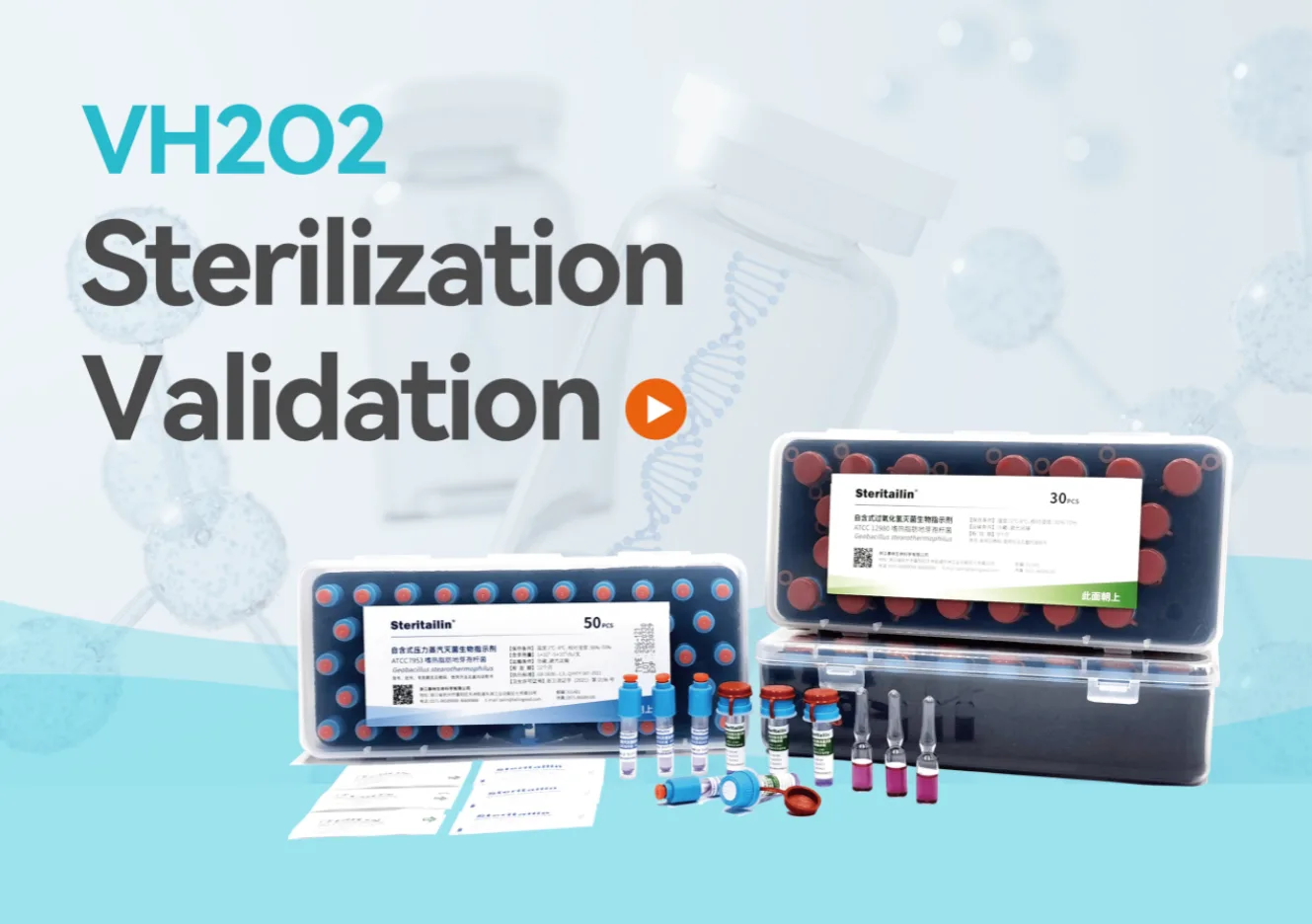
In the fields of pharmaceutical engineering and life sciences, VH2O2 sterilization has become the preferred solution for aseptic isolators, sterile pass boxes, and cleanroom decontamination due to its high efficiency, zero residue, and excellent material compatibility.
However, how can the sporicidal efficacy of an invisible gas be proven? This requires the establishment of a rigorous sterility assurance system. In this system, BIs and CIs play an irreplaceable and highly complementary role. Understanding their synergistic working principles is the key to ensuring compliance with international pharmacopeias (USP/EP) and the latest sterile manufacturing regulations.
1. CIs: The “Immediate Sentinel” of the Sterilization Process
Coated with special sensitive chemicals. In the VH2O2 sterilization process, the primary role of a CI is to provide rapid feedback on physical exposure.
- Working Mechanism:When the hydrogen peroxide concentration, exposure time, and temperature in the environment reach a specific threshold, the color-changing ink on the CI undergoes an irreversible chemical reaction (e.g., changing from purple to yellow).
- Core Value: Operators can visually determine whether the gas has successfully covered the monitoring point immediately after the sterilization cycle ends. It effectively prevents the mix-up of “processed” and “unprocessed” items.
- Limitations:The color change of a CI only proves that the sterilant has “reached” the area; it does not represent that microorganisms have been completely eradicated.
2. BIs: The “Ultimate Referee” of Sterility Assurance
If CIs monitor the “process,” then BIs validate the “result.” Biological indicators directly challenge the ability of the sterilization process to kill the most resistant microorganisms.
- Working Mechanism: VH2O2 sterilization typically utilizes spores of Geobacillus stearothermophilus, which have an extremely high resistance to hydrogen peroxide. After sterilization, the BI is placed into a dedicated culture medium for incubation. If no colony growth occurs, the sterilization is proven successful.
- Core Value:It is the only direct biological evidence proving that the sterilization process has achieved a 10⁻⁶ Sterility Assurance Level (SAL). In annual re-validations and routine batch releases, a negative BI result is an indispensable legal basis.
- Technical Tip: For VH2O2, stainless steel carriers must be used. Unlike paper or fiber, they do not absorb/decompose H2O2, ensuring data authenticity in high-end equipment like isolators.
3. The Synergistic Matrix of BIs and CIs
In an actual pharmaceutical production environment, a single indicator cannot provide complete quality assurance. According to the Contamination Control Strategy (CCS) concept of EU GMP Annex 1, BIs, CIs, and physical parameters (temperature, humidity, H2O2 injection volume) must form a “trinity” closed-loop monitoring system.
| Monitoring Dimension |
CI |
BI |
Synergistic Decision Logic |
| Speed |
Immediate (Post-cycle) |
7 Days (Typical incubation) |
CIs provide rapid safety confirmation before moving forward; BIs provide the final basis for quality release. |
| Monitoring Focus |
Gas distribution, penetration, and exposure level |
Actual microbial lethality (SAL) |
Both are placed at the “worst-case” locations determined during validation. |
| Result Interpretation |
Unchanged: Sterilization definitely failed.
Changed: Process ran normally. |
Positive: Sterilization failed (live bacteria present).
Negative: Sterilization completely successful. |
If the CI changes color but the BI is positive, the gas arrived, but the concentration/time was insufficient to kill the spores. Sterilization parameters must be re-optimized. |
4. Industry Applications and Practical Recommendations
Establishing a robust sterility assurance system begins with selecting the appropriate validation consumables. When selecting BIs and CIs, pharmaceutical companies should focus on batch-to-batch stability, the accuracy of the D-value, and the permeability of the packaging materials.
Tailin has developed a range of biological and chemical indicators optimized for VH2O2 sterilization, with designs referencing relevant ISO standards. By integrating high-performance indicators with Tailin’s advanced vaporized hydrogen peroxide generators and aseptic isolation technology, pharmaceutical companies can establish a more robust monitoring system, better aligning with USP and EP pharmacopeial requirements while enhancing overall sterilization validation efficiency.
Conclusion
In the system of H2O2 sterilization validation, chemical and biological indicators serve distinct but complementary roles. CIs provide a quick reference for the process, while BIs are central to microbial challenge validation. A thorough understanding of their collaborative logic, combined with a science-based mapping strategy, helps pharmaceutical companies build a more transparent, compliant, and risk-based contamination control system.
For more information or to explore partnership opportunities, please visit our website or contact us at phone: +86 571 8658 9087, email: marketing@tailingood.com. Stay connected with Tailin through our social media channels on Facebook, YouTube, LinkedIn and Instagram to witness our ongoing journey toward excellence and innovation.
Read Our One More Blog: Application of VH2O2 Gas Concentration Analyzer in Aseptic Packaging Lines