




Anyone who has spent time around pharmaceutical manufacturing or microbiology labs knows the drill: contamination control isn’t optional, it’s the whole game. That’s where a VHP generator earns its keep. Vaporized hydrogen peroxide has become one of the go-to methods for knocking out bacteria, viruses, and resistant spores without leaving chemical residue behind, and Tailin has built its reputation around making that process dependable, repeatable, and easy to validate.
What a VHP Generator Actually Does
At its core, a VHP generator takes liquid hydrogen peroxide and turns it into a dry vapor that can move through a sealed space and reach every surface — corners, seams, equipment housings, the works. Tailin designs its VHP generators using flash evaporation technology to produce consistent, dry hydrogen peroxide vapor, which matters because inconsistent vapor means inconsistent kill rates, and in a regulated environment that’s simply not acceptable.
The numbers back this up. The technology can reduce microbial contamination to a 6-log reduction level, meaning a 99.9999% kill rate. That’s the kind of assurance labs need before they release a batch, run a sterility test, or hand equipment over for the next experiment.
How Tailin’s Flash Evaporation Technology Works
Rather than relying on a slow heating process, Tailin’s system converts food-grade hydrogen peroxide into gas almost instantly. TAILIN Decontamination VHP Generator converts the 35% food grade H2O2 liquid into gaseous by flash evaporation technology, and the complete cycle includes pre-heat, adjusting, sterilization and ventilation stages. Each stage has a purpose — the pre-heat gets the chamber ready, adjusting brings humidity and concentration into the target range, sterilization does the actual work, and ventilation clears the space so it’s safe to re-enter or reload.
It sounds simple written out like that, but getting the timing right across all four stages, cycle after cycle, without drift, is really the hard engineering problem. That consistency is what separates a generator that passes validation once from one that holds up under routine use.
Built-In VHP Generator for Isolator Applications
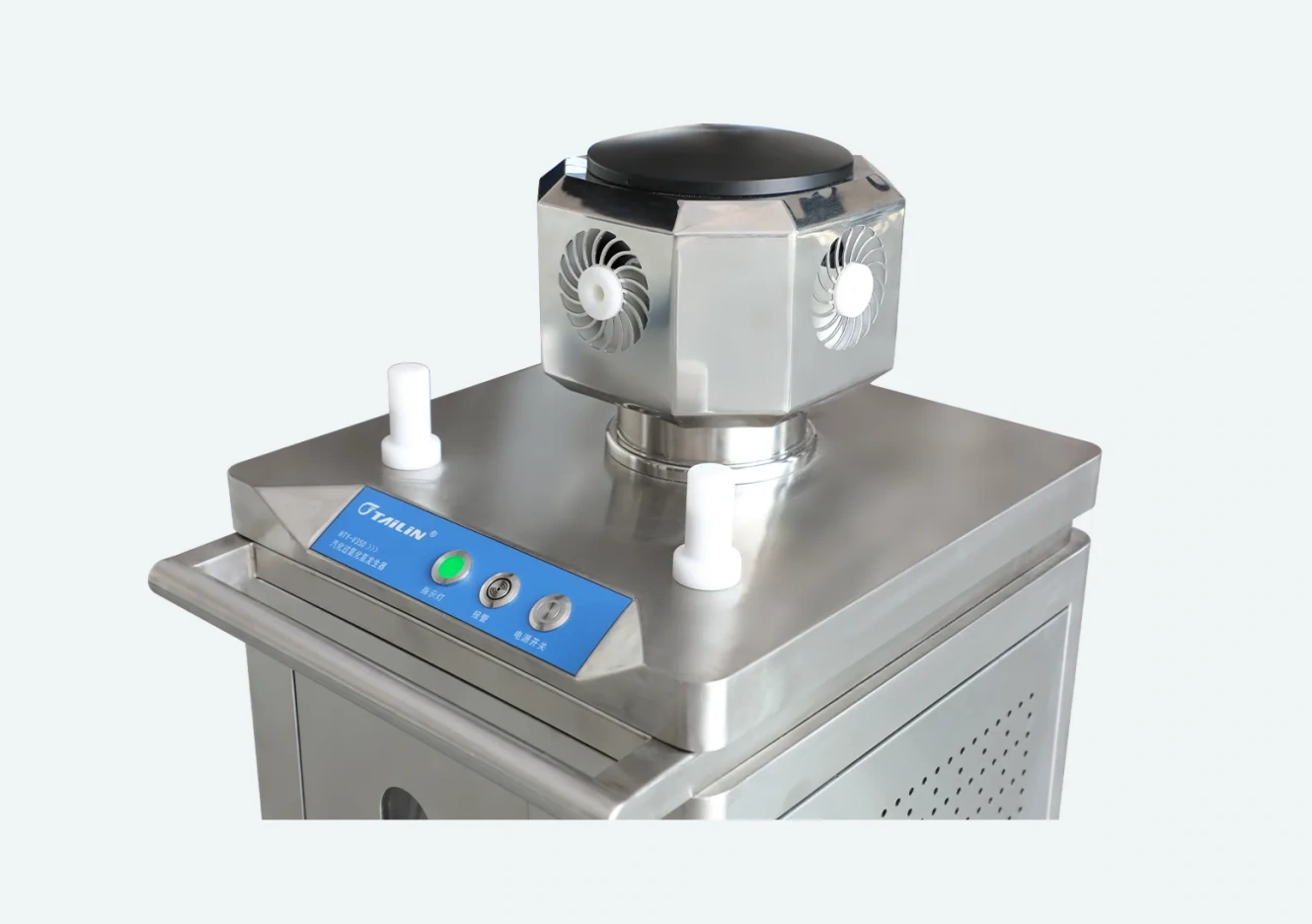
Isolators present a unique challenge. They’re small, sealed, and often packed with sensitive equipment, so you can’t just spray disinfectant and hope for even coverage. This is where a built-in VHP generator for isolator setups makes a real difference — the unit is integrated directly into the enclosure’s airflow path rather than bolted on as an afterthought.
Why Isolators Need Integrated Vapor Systems
Smaller VHP generator models, like the HTY-V100, are specifically designed for confined spaces such as isolators, transfer passages, biosafety cabinets, and even small clean rooms, making them suitable for online sterilization. Because the generator is built into the system, vapor distribution stays uniform even in tight geometries, and operators don’t have to move a separate cart or connect external hoses every time a cycle runs. For labs doing frequent turnover between samples or products, that convenience adds up fast.
VHP Generator for Enclosure Sterilization
Not every application involves a dedicated isolator, though. Sometimes the job is sterilizing a biosafety cabinet, a transfer chamber, or an entire room, and here a standalone VHP generator for enclosure sterilization does the heavy lifting. Tailin’s larger units deliver advanced VHP sterilization through flash vaporization, precise monitoring, and uniform 360° distribution to eliminate microorganisms in enclosed spaces up to 400 m³.
From Biosafety Cabinets to Full Cleanrooms
In labs where researchers handle potentially hazardous microorganisms, VHP generators are used to decontaminate equipment, biological safety cabinets, and entire rooms between experiments. Pharmaceutical cleanrooms lean on the same principle, just at a larger scale, since even a small pocket of contamination can compromise an entire production run. It’s also worth mentioning that this isn’t limited to pharma — Tailin has extended similar closed-loop VH2O2 sterilization approaches to beverage filling lines, treating bottles and caps in-line before they ever reach the product.
A Quick Look at Sterility Test Isolators
While we’re on the topic of isolators, it’s worth touching briefly on sterility test isolators, since they’re one of the more demanding use cases for this kind of technology. Tailin’s HTY and CST Series Sterility Test Isolators deliver GMP Grade A environments with a stainless steel and tempered glass rigid structure, dynamic Class A airflow, and efficient VH2O2 decontamination. The system incorporates Tailin’s latest-generation VHP sterilization technology, with precise control of hydrogen peroxide concentration and saturation enabling rapid, effective bio-decontamination of the chamber interior before operations begin. Residual hydrogen peroxide typically drops below 1 ppm after aeration, which keeps both the tester and the samples safe once the cycle finishes. It’s a good example of how a well-integrated VHP system does more than just clean — it becomes part of the whole quality assurance chain.
Meeting GMP and Regulatory Expectations
None of this matters much if it can’t be validated. VHP generators are routinely used for cleanroom sterilization because they can be traced and validated to comply with GMP standards, and they can also be integrated into isolators, transfer chambers, and HEPA filter sterilization processes. Documentation, traceability, and repeatable cycle data aren’t nice extras here — they’re what auditors and quality teams actually check first. Tailin builds its systems with that scrutiny in mind, so the data generated during a cycle can stand up to review rather than needing extra justification later.
There’s no single “best” VHP generator — it really depends on what you’re sterilizing and how often. A small lab running frequent isolator cycles will want something compact and built-in, while a facility managing whole rooms or production lines needs higher throughput and wider vapor distribution. Tailin’s range covers both ends, from the compact HTY-V100 up through larger units suited to full cleanroom decontamination, so it’s worth matching the generator to the actual footprint and workflow rather than defaulting to the biggest unit available. Getting that match right is usually what determines whether a decontamination program runs smoothly for years or turns into a recurring maintenance headache.
For detailed information, please visit our website or reach out via +86-571-8658-9087 or marketing@tailingood.com. Follow Tailin on Facebook or Linkedln to explore more about the company’s technologies, applications, and future developments.
Read Our One More Blog: Tailin Hydrophilic PES Membrane for High-Efficiency Filtration
