All Solutions
Home > Biological Indicators > Biological Indicators
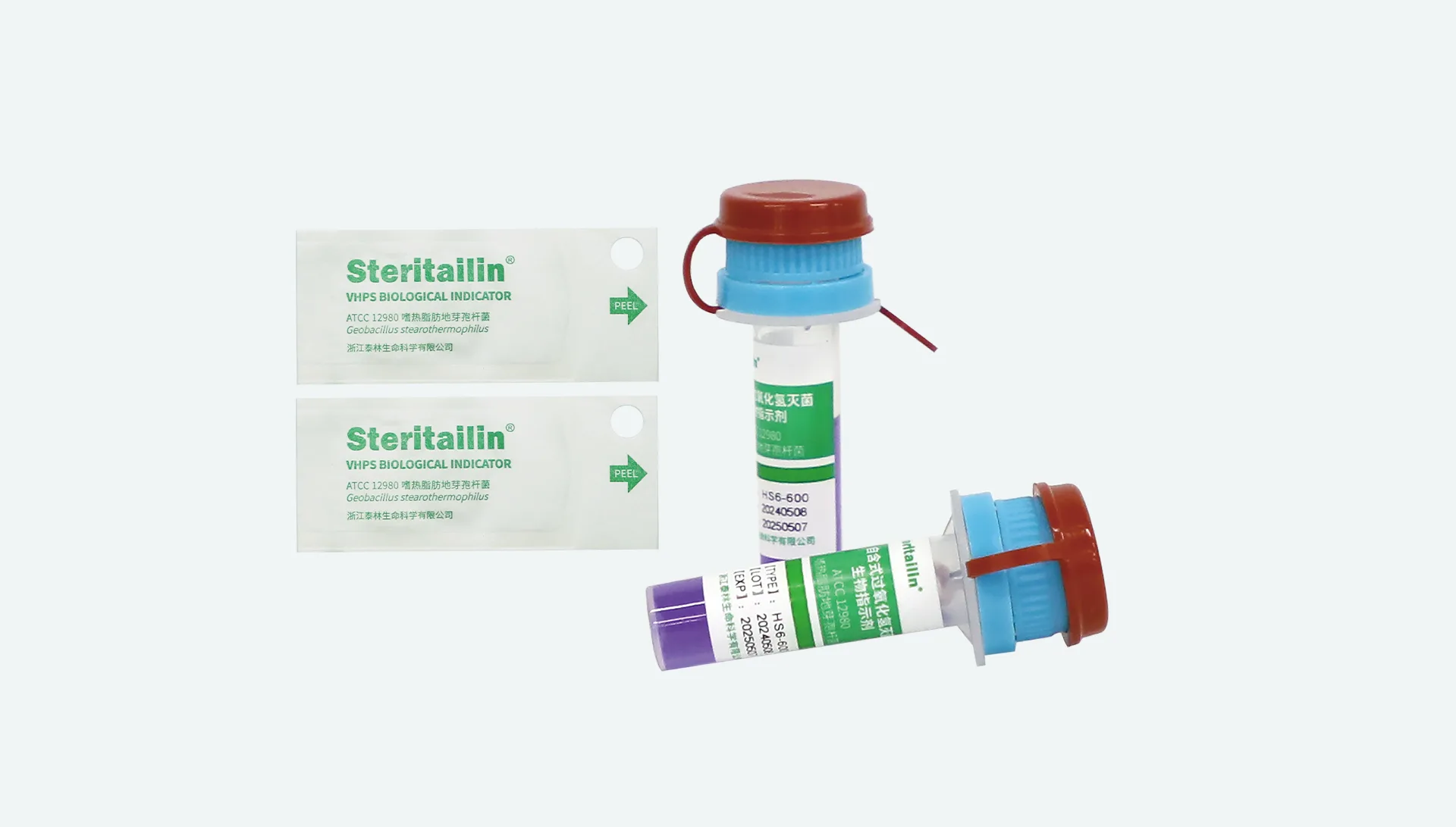
BIs for Vaporized Hydrogen Peroxide
Specially designed to meet the needs of the pharmaceutical, food, and medical device industries using vaporized & atomized hydrogen peroxide decontamination
Biological indicators are the ideal process indicators that directly monitor the lethality of a given sterilization process. Tailin’s biological
indicators meet the requirements of ISO 11138, GB18281, GMP, PDA TR51, FDA 510k and Pharmacopoeia (USP, EP, ChP). The spores
used are traceable and the test report includes spore concentration, D-value, and other relevant data.
Biological indicators are suitable for pharmaceutical enterprises, medical device industries, CDC, biosafety laboratories and so on. Tailin’s biological indicators are of reliable quality and complete types, and can provide professional technical support for users.
No. According to ISO 11138, BIs are defined as the only means to provide direct evidence of microbial kill. USP <1229> further clarifies that while physical and chemical monitoring provide real-time data, they are “indirect” measures.
The color change of a CI only proves that the sterilant has “reached” the area; it does not represent that microorganisms have been completely eradicated. In annual re-validations and routine batch releases, a negative BI result is an indispensable legal basis.
According to the latest industry insights and USP 2025 guidelines, VH2O2 sterilization is a complex process influenced by fluctuating variables: concentration, temperature, relative humidity, and saturation levels.
Because these parameters are difficult to control precisely and uniformly, current regulatory documents do not specify a universal D-value for BIs in this application. Instead, efficacy must be confirmed through empirical testing and historical data for each specific cycle.
Since it is technically challenging to intuitively identify absolute “worst-case” locations for vaporized hydrogen peroxide (VH2O2), regulatory frameworks mandate a density-based and empirical approach to ensure sterilization efficacy:
Placement Strategy: Rather than guessing, BIs must be dispersed in areas where gas diffusion is structurally restricted—such as corners, shadowed zones, and complex equipment geometries. This validates that the sterilization gas reaches even the most difficult-to-diffuse points.
Required Quantity (PDA TR34 Standards): For aseptic isolators, PDA TR34 recommends placing 5 to 10 BIs per square meter. This density is required to confirm that the H2O2 vapor distribution is uniform and meets the required lethality across the entire enclosure.
Determining Minimum Conditions (USP 2025): The final placement and cycle parameters (primarily exposure time) must be confirmed through testing. Based on USP 2025, if any BIs remain active after a cycle, parameters must be adjusted until complete inactivation is achieved. This empirical result defines the “minimum sterilization conditions” for your specific validation protocol.
Yes. Tailin states that its Biological Indicators comply with multiple international standards and guidelines, including ISO 11138, USP, EP, GMP, PDA TR51, FDA 510(k), and GB18281 requirements. In addition, the spores are traceable and test reports include important validation data such as spore concentration and D-values.
The self-contained design helps reduce operator handling steps and lowers contamination risk. Tailin also uses medical-grade dialysis paper packaging that both prevents external contamination and ensures adequate steam penetration during sterilization cycles.