




If you’ve spent any time around a pharmaceutical water system, you already know that “clean” isn’t a feeling — it’s a number. Purified Water and Water for Injection have to meet exact standards before they touch a product, and the instrument doing most of that heavy lifting is the TOC Analyzer.
TOC stands for Total Organic Carbon, and the analyzer’s job is simple to describe but hard to get wrong: it tells you how much organic material is hiding in your water. Bacteria, biofilm residue, cleaning agent traces, even leftover packaging compounds — all of it shows up as organic carbon. A rising TOC number is usually the first sign that something in the water system needs attention, often weeks before a microbial test would catch it.
Why TOC Matters More Than People Realize
A lot of quality teams treat TOC testing as a box to check for USP <643>, EP 2.2.44, or JP <2.59>. Fair enough — it is a compliance requirement. But the analyzer earns its keep well beyond the audit binder.
An Early Warning System
Microbial contamination doesn’t appear out of nowhere. It builds up gradually, usually starting with a thin layer of biofilm on pipe walls or a dead leg in the distribution loop that nobody flushes properly. That buildup releases organic carbon long before colony counts spike. A well-placed online TOC analyzer picks up that trend and gives engineers time to intervene — cleaning a line, adjusting sanitization cycles — instead of scrambling after a failed batch release.
Cleaning Validation Without the Guesswork
After a cleaning cycle, someone has to prove the equipment is actually clean, not just that it looks clean. Swab testing works, but it’s slow and only samples a small surface area. TOC-based cleaning validation rinses the whole system and measures what comes out, giving a far more representative picture of residual contamination. Manufacturers running multi-product lines lean on this heavily, since cross-contamination risk is exactly what regulators care most about.
What Goes On Inside the Instrument
Most pharmaceutical-grade TOC analyzers rely on one of two oxidation approaches, and it’s worth knowing the difference before choosing equipment.
UV Oxidation and Conductivity Detection
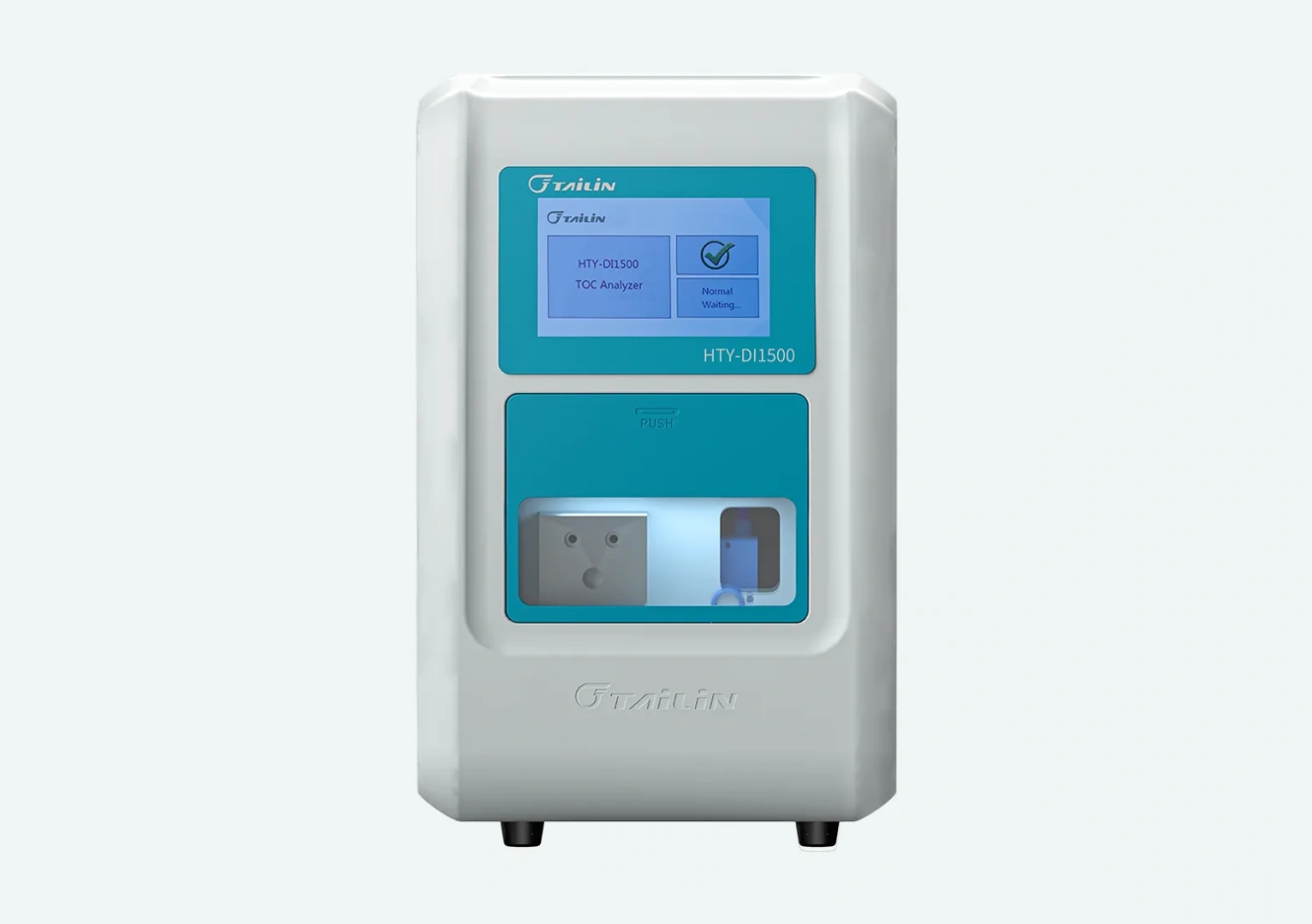
A UV lamp breaks down organic molecules in the sample, converting the carbon into carbon dioxide. That CO2 changes the conductivity of the water, and the analyzer converts that shift into a TOC value. Tailin’s DI1500, for example, uses dual-wavelength UV oxidation paired with direct conductivity detection, which keeps the measurement stable without needing chemical reagents — a real advantage when you’re trying to reduce consumable costs and disposal headaches in a GMP lab.
High-Temperature Combustion
For samples with tougher organic compounds — think environmental water, wastewater, or certain process streams — combustion-based oxidation at high temperature does a more thorough job breaking things down. Tailin’s GM2000/3000 series takes this route, using UV plus persulfate oxidation with membrane conductometric detection, and it holds calibration stability for an unusually long stretch, which cuts down on maintenance visits.
Ultra-Low Detection for Ultrapure Water
Semiconductor-grade ultrapure water and certain pharmaceutical applications need sensitivity in the parts-per-billion range, sometimes lower. The HTY-DC200e pushes detection down to around 0.03 ppb, with self-developed UV oxidation and conductivity modules, so operators get real-time alerts the moment a water system starts drifting instead of finding out during the next scheduled test.
Choosing Between Online and Laboratory Analyzers
There’s no single right answer here — it depends on how the water is used.
- Online analyzers sit directly in the distribution loop and monitor continuously. They’re the go-to for Purified Water and WFI systems where any deviation needs to be caught immediately, not discovered during a periodic grab-sample check.
- Laboratory analyzers handle batch samples, cleaning validation rinses, and one-off investigations. They tend to offer broader sample flexibility since they’re not tied to a fixed line.
Many facilities run both: an online unit for continuous loop monitoring and a lab unit for validation work and troubleshooting. It’s not redundant — it’s two different jobs.
A Word on Data Integrity
Since 21 CFR Part 11 and GMP data integrity requirements aren’t going anywhere, the software behind a TOC analyzer matters almost as much as the hardware. Audit trails, electronic signatures, and a proper SQL database for storing results are no longer nice-to-haves. Instruments that skip this layer end up creating extra paperwork burden for quality teams later, which somewhat defeats the point of automating the testing in the first place.
Where a Sterility Test Isolator Fits Into the Bigger Picture
TOC monitoring keeps water systems clean, but water is only one part of aseptic manufacturing. Once a product is filled and ready for sterility testing, it needs to be handled in an environment that’s isolated from operators and the surrounding room air. That’s where a sterility test isolator comes in — a fully enclosed, ISO 5 / Grade A chamber that keeps the testing environment sealed off from outside contamination while technicians work through glove ports. Used alongside a sterility test pump, it lets labs run membrane filtration sterility tests with a much lower risk of false positives caused by incidental contamination during handling. Between reliable water quality monitoring and a properly isolated testing environment, manufacturers cover two of the biggest contamination risk points in the whole production process.
A TOC analyzer isn’t the most talked-about instrument on a pharma production floor, but it’s doing constant, quiet work — flagging problems in the water system before they turn into batch failures, backing up cleaning validation with real data, and keeping compliance teams out of trouble during inspections. Whether it’s an online unit watching a WFI loop around the clock or a lab analyzer confirming a cleaning cycle actually worked, the right TOC setup pays for itself the first time it catches something a routine microbial test would have missed too late.
Tailin stands as a reliable and forward-thinking brand in the life science and bioengineering sector. With a solid foundation in technology innovation and quality manufacturing, the company has built a comprehensive product ecosystem covering isolation systems, sterile testing solutions, filtration technologies, and microbiological analysis equipment. These solutions are widely trusted by pharmaceutical companies, laboratories, and research institutions around the world. For detailed information, please visit Tailin’s Website or reach out via +86-571-8658-9087 or marketing@tailingood.com. Follow Tailin on Facebook or Linkedln to explore more about the company’s technologies, applications, and future developments.
Read Our One More Blog: Tailin VHP Generator for Reliable Cleanroom Decontamination
