




If you’ve ever stood near a hammer mill running a potent API, you know the machine isn’t the real problem. The dust is. Fine particles hang in the air longer than most people expect, and with compounds used in ADCs, peptides and oncology drugs, a tiny amount is already too much. A containment isolator exists for exactly that situation, and Tailin builds its range around one simple idea: keep the operator and the powder completely apart.
Where Exposure Really Happens
Crushing and weighing are the risky steps
Most of the exposure risk in API production sits in two steps. Crushing adds mechanical energy, which breaks particles down and throws them into the air. Weighing and dispensing then add open handling on top. In a traditional setup the mill and the balance are separate machines, so material gets moved, lids get opened, and every transfer is another chance for dust to escape.
What OEB 5 asks of your equipment
OEB 5 sits at the top of the occupational exposure banding scale, so the equipment has to prove it contains, not just claim it. Tailin’s isolators are designed for OEB 4 and 5 compounds and verified through third-party containment testing. The crushing and weighing model reports leak rates better than the ISO 10648-2 requirement.
How a Tailin Containment Isolator Works
Negative pressure and filtration
The working chamber runs under negative pressure, driven by a high-pressure exhaust fan. Air moves inward, never out, so nothing drifts toward the operator or the room. Exhaust passes through H14 push-push HEPA filters with a filtration efficiency of 99.995% (H14 grade according to EN 1822) for penetrating particles. They can be swapped and integrity-tested without tools, which matters more than it sounds when you’re changing a filter on a potent-compound line.
Gloves, doors and windows
Operators work through an integrated glove system (8Y gloves on the crushing and weighing unit), with EPDM, neoprene or Hypalon available depending on your solvents. Doors use inflatable seals that adjust for small gaps and keep sealing pressure even over time. The viewing windows are 15 mm tempered glass. Where the process needs more reach, such as rotary evaporation, half-suits can replace gloves.
Moving material in and out
A continuous liner system handles transfers, so powders go in and out without breaking containment. It’s one of those details that separates a real containment isolator from a glovebox with good intentions.
OEL 5 High Containment Isolator for Crushing and Weighing
Mill and balance in one closed chamber
This is the model we’d point most API teams toward. A heavy-duty hammer mill sits at the back of the chamber, its feed inlet reaching into the work area and its discharge pointing straight at the weighing zone. You feed, crush and weigh without ever leaving the closed environment. The interior measures 1914 × 750 × 800 mm, roomy enough for long batches without cramped wrists.
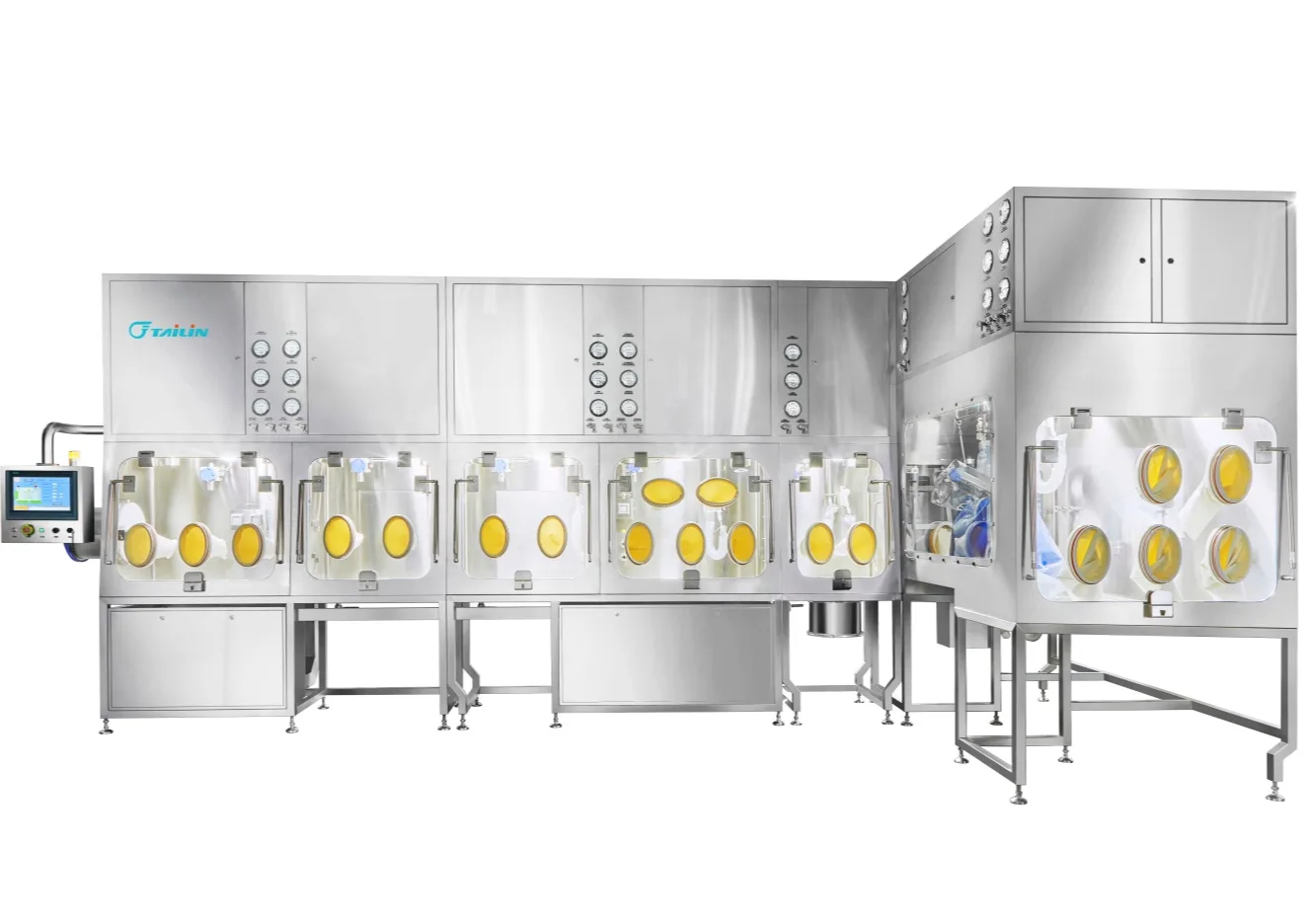
Replaceable screens from 0.5 to 3.0 mm give output between roughly 20 and 200 mesh, which covers lyophilized blocks, crystalline lumps, plant extracts and tougher polymer-type materials. Batches run from 100 g to 10 kg, so the same design suits pilot work and production. Because crushing and conveying are fully enclosed and the HEPA filters retain fine particles, system yield stays at 95% or higher. With expensive APIs, that number pays for itself.
Weighing that holds steady
Weighing inside a running isolator is harder than it looks. Vibration, airflow and pressure swings all push the reading around. Tailin puts the balance on an independent anti-vibration table, uses CFD modeling to keep drafts off the pan, and holds accuracy between ±0.1 g and ±0.01 g while the mill and blowers are running. Higher-grade balances can be fitted when a process needs them.
Custom Barrier Containment Isolator Options
Configurations for different processes
No two processes match, so Tailin treats the custom barrier containment isolator as the normal case rather than a special request. The crushing and weighing line alone comes in a standard version, a drying-integrated version for post-wet-granulation work, and a simplified version focused on precise weighing with light size reduction.
Wider range and solvent safety
Beyond that, the range covers weighing and sampling, freeze-drying with weighing and capping, multifunctional negative-pressure synthesis, and feeding in highly corrosive environments. The ADC-oriented unit combines rotary evaporation, filtration, drying, weighing, dispensing and capping in one enclosure, with weighing accuracy of 1/10,000. Solvent work is covered too: internal explosion-proofing is standard, and fully explosion-proof builds meeting EXd II BT4 and ATEX are available.
Controls, Data and Validation
Control system and data integrity
Control runs on a Siemens touch screen and S7-series PLC. The system logs temperature, humidity and differential pressure with time stamps and user IDs, in line with FDA 21 CFR Part 11. Differential pressure is watched live, and abnormal readings trigger alarms and interlocks. If you want the data in your plant systems, optional OPC UA and Modbus TCP modules push runtime data, alarm logs and batch records to MES.
Validation support
On validation, Tailin supports the full chain: DQ, FAT, SAT and IQ/OQ/PQ. For anyone who has chased missing paperwork before an inspection, that’s worth asking about early.
Who Uses Containment Isolator Systems
Typical applications
These containment isolator systems show up in high-potency labs doing weighing, sampling, solution prep and moisture titration. They’re used in API production for centrifugation, filtration, drying, mixing, milling and dispensing, and in solid dosage work such as granulation, tablet compression and coating. ADC small-molecule synthesis, HPAPI processing, peptide dissolution and oncology drug handling are common fits.
Start with the compound’s exposure band, then walk through the process step by step and mark every point where powder is open to the air. Those are the places the isolator has to cover. Ask about solvents, batch size, weighing precision and how you’ll transfer material, because those four answers drive most of the configuration.
Tailin has been building life-science equipment since 2002, and its isolators are made to be fitted around a real process. For detailed information, please visit our website or reach out via +86-571-8658-9087 or marketing@tailingood.com. Follow Tailin on Facebook or Linkedln to explore more about the company’s technologies, applications, and future developments.
Read Our One More Blog: Smarter Sterility Testing with Tailin Sterility Test Isolator
