




A failed sterility test is a bad day for any QC lab. The frustrating part is that a positive result doesn’t always mean the product was contaminated. Sometimes the contamination came in with the operator, a glove, or a transfer that didn’t go quite right. That’s the problem a good isolator is meant to remove, and it’s the reason more labs are moving sterility testing out of open cleanrooms and into closed systems.
What Is a Sterility Test Isolator?
A sterility test isolator is a sealed workstation that keeps a Grade A (ISO 5) environment around your samples while operators work through glove ports. Nobody puts their hands or body near the product. Filtered air moves through the chamber, and the interior is decontaminated between runs, usually with vaporized hydrogen peroxide. The point is simple: if a test comes back positive, you can trust it, and if it comes back negative, you can trust that too.
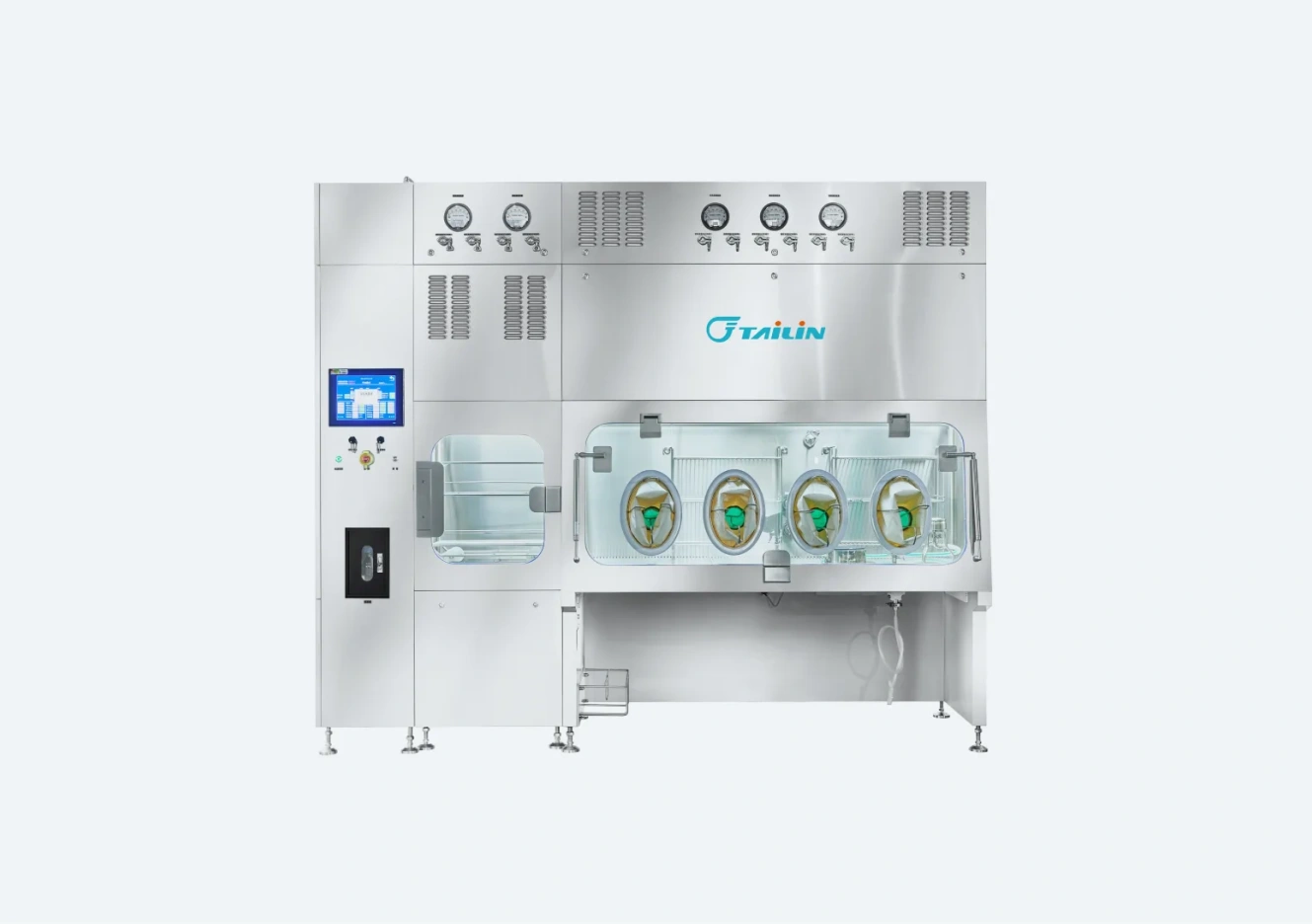
Why Tailin’s Approach Works for QC Labs
Tailin has been building aseptic isolators for about 20 years, and the company developed what it says was the first biological isolator in China. That history shows in the details. The HTY and CST series are built around what a QC analyst actually does all day, not around a spec sheet.
A Hard Wall Sterility Testing Isolator Built to Last
Tailin’s chambers are a hard wall sterility testing isolator design: stainless steel frames with tempered glass panels, rather than flexible film. Rigid walls hold their shape, clean easily and stand up to repeated decontamination cycles without fatigue. They also make leak testing more repeatable, since the chamber isn’t flexing around. Inflatable silicone seals, approved for GMP use, keep the door and panel joints tight.
Control runs on a Siemens PLC, so the cycle is automated instead of depending on someone remembering the right sequence. The interior stays at Class A through laminar airflow and H14 HEPA filtration. For sites that need electronic records, the HTY series supports 21 CFR Part 11 requirements, including electronic signatures.
Decontamination You Can Count On
Every batch of testing starts with a clean chamber. Tailin builds its own VHP generator into the isolator, and it’s designed to reach a 6-log sterility assurance level. Concentration and saturation are monitored during the cycle, and after aeration the residual hydrogen peroxide drops below 1 ppm. That last number matters more than people think. Leftover peroxide can interfere with the very organisms you’re trying to detect, so low residuals protect the test itself.
Leak Testing That Doesn’t Slow You Down
The chamber is tested for leaks automatically. Tailin quotes a leakage rate below 0.5% of volume per hour at twice the working pressure, which is a comfortable margin. Gloves get their own attention, because they’re the weakest part of any isolator. The GIT series tests each glove separately using the pressure decay method described in ISO 14644-7. A pinhole you can’t see becomes something you catch before a run rather than after.
Sterility Test Isolator Validation Protocol: What to Plan For
Buying the equipment is the easy half. Your sterility test isolator validation protocol is what proves to an inspector that the system does what you claim. Every site writes it a little differently, but most protocols cover the same ground.
Qualification and Physical Integrity
Start with the usual IQ, OQ and PQ sequence. Installation checks confirm the isolator matches the design and documentation. Operational testing covers HEPA filter integrity, airflow patterns, pressure differentials, alarms and the control system. Leak rate testing and glove integrity testing sit here too, and they should be repeated on a schedule, not just at commissioning.
Decontamination Cycle Development
This is where most of the effort goes. You need to develop a VHP cycle, then show it works with biological indicators placed at the hardest-to-reach spots in the chamber. Load configuration matters. A cycle that works on an empty isolator can behave differently once trays, canisters and a sterility test pump are inside. Aeration time needs to be validated as well, so residuals are proven low before any sample goes in. Tailin offers sterilization cycle development and validation support, which saves a lot of back-and-forth for teams doing this for the first time.
Performance and Environmental Monitoring
Finally, run the process the way you’ll run it in real life. That includes transfers in and out, operator interventions, media fills or simulated tests, and environmental monitoring with settle plates, contact plates and particle counts. Run enough repeats to show the results are consistent, not lucky. Then set up a requalification schedule so the validated state doesn’t quietly drift.
Fitting the Isolator Into Your Facility
One benefit people sometimes overlook is the room around the isolator. EU GMP Annex 1 and PIC/S guidance allow sterility testing inside an isolator that sits in a Class C or Class D background. That can mean lower cleanroom demands, less air conditioning load and lower running costs, without giving up sterility assurance.
Tailin’s CST series adds modules depending on what your workflow needs, such as sterile pass boxes, rapid transfer ports, built-in sterility test pumps, sterile liquid transfer ports and BIBO filters. Environmental monitoring and glove testing can be integrated too. The operator panel angle, lighting and working height are adjusted for comfort, which sounds minor until someone spends six hours a day at the isolator.
If your team runs regular sterility tests for sterile preparations, biologics or radiopharmaceuticals, a hard wall isolator with built-in decontamination and automated integrity testing removes a lot of variables. You’ll spend less time chasing false positives and more time on the work that matters. Tailin can tailor configurations to your throughput and space, and its pump and canister systems fit into the same workflow.
Before you commit, work out your batch volumes, your transfer needs and how your validation team wants to handle cycle development. A short conversation with Tailin’s engineers up front tends to save weeks later. You can find the HTY and CST series details at https://www.tailinscitech.com/. For inquiries, contact +86-571-8658-9087 or email marketing@tailingood.com. Stay connected through Tailin’s official YouTube or Linkedln channels for the latest updates and insights.
Read Our One More Blog: Tailin PVDF Membrane: Built for Reliable Laboratory Results
