




In modern pharmaceutical manufacturing, maintaining a sterile production environment is essential for protecting both products and personnel. Barrier systems such as isolators and Restricted Access Barrier Systems (RABS) play a critical role in preventing contamination, but their effectiveness depends heavily on one key component—the integrity of the protective gloves.
Even a tiny puncture or leak can compromise the sterile barrier, leading to contamination risks, production losses, and regulatory non-compliance. This is why a Glove Integrity Tester has become an indispensable tool in aseptic manufacturing. By performing accurate and repeatable Glove Leak Test procedures, manufacturers can verify glove sealing performance, satisfy regulatory requirements, and maintain confidence in every production batch.
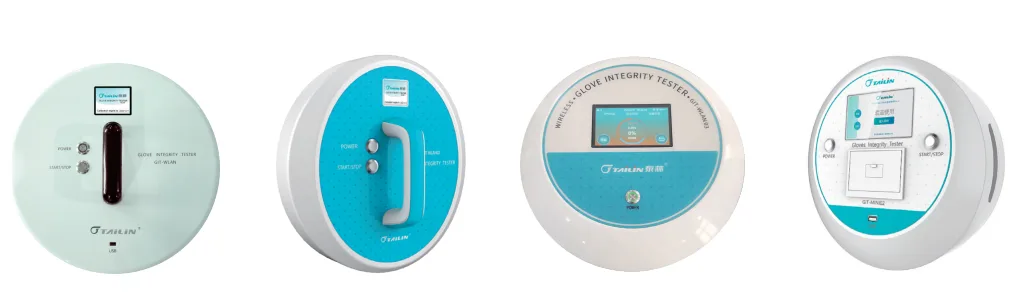
Why Glove Integrity Testing Matters
Protective gloves installed on isolators and RABS are continuously exposed to mechanical stress during routine operations. Over time, small defects that are invisible to the naked eye may develop, allowing microorganisms or hazardous substances to pass through the barrier.
Automated glove integrity testing provides an objective method for verifying glove performance before these defects become serious contamination risks. Compared with manual visual inspection, pressure decay testing delivers more reliable, repeatable, and traceable results, making it the preferred solution for GMP-regulated environments.
Regulatory Requirements for Glove Leak Test
Regulatory agencies around the world emphasize routine glove integrity verification as an essential part of contamination control.
According to EU GMP Annex 1, glove integrity testing should be performed at defined intervals and at least at the beginning and the end of each production batch. This requirement highlights the importance of continuous verification rather than relying solely on visual inspection.
Modern Glove Integrity Tester systems also support compliance with multiple international standards, including:
- ISO 14644-7 for repeatable and verifiable glove integrity testing
- 21 CFR Part 11 for electronic records and electronic signatures
- CE Certification
- CNAS Certification
These certifications help manufacturers simplify audits while ensuring data integrity throughout the testing process.
Applications Across Multiple Industries
Although glove integrity testing is most commonly associated with pharmaceutical manufacturing, its applications extend far beyond cleanroom production.
Pharmaceutical and Biotechnology
In aseptic production facilities, routine Glove Leak Test procedures help maintain sterile processing conditions while ensuring compliance with GMP regulations. Regular testing reduces contamination risks and supports batch release confidence.
Food Industry
Food manufacturers use glove integrity testing to identify pinhole defects in food-processing gloves. This supports HACCP requirements by preventing microbial contamination caused by damaged protective gloves.
High-Risk Industrial Protection
Chemical manufacturers rely on glove testing to verify the sealing performance of acid-resistant, alkali-resistant, and solvent-resistant gloves, reducing the risk of chemical permeation and operator injury.
Within the nuclear industry, glove integrity verification minimizes the possibility of exposure to radioactive substances by ensuring the effectiveness of radiation-protection gloves.
Scientific Research and Environmental Safety
Universities and research laboratories use Glove Integrity Tester systems to improve laboratory safety procedures and operator protection.
Environmental monitoring and hazardous waste disposal facilities also benefit from reliable glove testing while meeting OSHA, EPA, and other regulatory expectations for worker safety.

Key Features of a Modern Glove Integrity Tester
Today’s automated systems combine precision measurement with intelligent data management to improve both operational efficiency and compliance.
High Detection Accuracy
One of the most important performance indicators is detection sensitivity. Under specified testing conditions and parameters, modern systems can detect leakage equivalent to a 100 μm defect, enabling early identification of glove damage before it becomes a contamination hazard.
RFID-Based Traceability
RFID technology automatically recognizes each glove’s identification number and links it directly to the corresponding test record. This eliminates manual recording errors while providing complete traceability throughout the glove lifecycle.
Precision Temperature Monitoring
An integrated high-precision temperature sensor monitors testing conditions with an accuracy of ±0.1°C, helping maintain stable measurements and improving the consistency of pressure decay testing.
Regulatory-Compliant Data Management
Electronic records that comply with 21 CFR Part 11 allow secure storage of testing results, while PDF report export simplifies documentation and audit preparation.
Portable and Efficient Operation
Modern Glove Integrity Tester systems are designed for daily production use, offering several convenience features, including:
- Fast charging in approximately 2 hours
- Universal charging interface
- Offline testing capability
- Exportable PDF reports
- Quick switching between test ports for improved workflow efficiency
These features reduce downtime while supporting routine glove verification across multiple production lines.
Improving Contamination Control Through Automated Glove Leak Test
Automated pressure decay technology provides a standardized testing method that minimizes operator variability and improves testing consistency. Instead of relying on subjective visual inspection, manufacturers obtain quantitative results that can be archived, reviewed, and audited whenever necessary.
As pharmaceutical regulations continue to place greater emphasis on contamination control strategies, automated Glove Leak Test procedures have become an essential part of modern quality assurance programs.
Reliable glove integrity verification is no longer simply a recommended practice—it has become a fundamental requirement for sterile manufacturing and contamination control.
A high-performance Glove Integrity Tester enables manufacturers to perform repeatable Glove Leak Test procedures that comply with international regulations while improving traceability, testing accuracy, and operational efficiency. With support for ISO 14644-7, 21 CFR Part 11, CE, and CNAS requirements, along with advanced features such as RFID identification, 100 μm leak detection, ±0.1°C temperature monitoring, rapid charging, offline testing, and PDF reporting, automated glove integrity testing provides a dependable solution for pharmaceutical, biotechnology, food processing, chemical, nuclear, and research applications. By integrating routine glove integrity verification into everyday operations, organizations can strengthen contamination control, protect personnel, and maintain the highest standards of product quality.
For more information, please visit Tailin’s website or contact Tailin directly at +86-571-8658-9087 or marketing@tailingood.com. You may also follow Tailin on Facebook, YouTube, LinkedIn and Instagram to stay updated on the latest products, technologies, and industry insights.
Read Our One More Blog: Tailin Containment Isolator Solutions for High-Potency Material Handling
