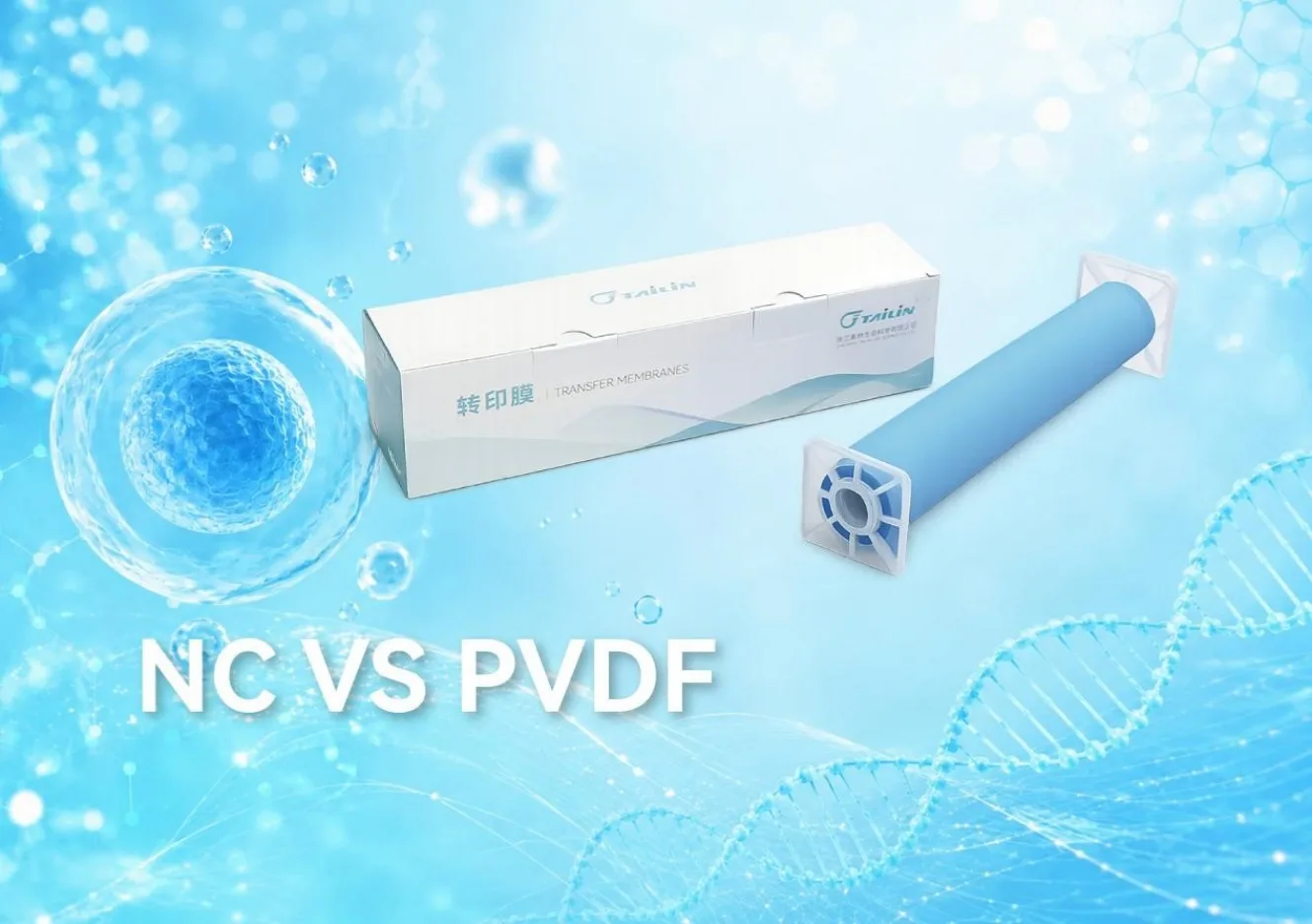
In Western blotting, once protein samples have been separated by gel electrophoresis, one important decision comes next: which transfer membrane should be used?
For many researchers, the choice between a nitrocellulose membrane and a PVDF membrane may seem routine. In practice, however, this decision can directly influence band clarity, signal intensity, background level, stripping performance, and overall result reliability.
Both NC and PVDF membranes are widely used in protein transfer applications, but they are not interchangeable in every experimental setting. Understanding their differences can help researchers build a more stable and reproducible Western blot workflow.
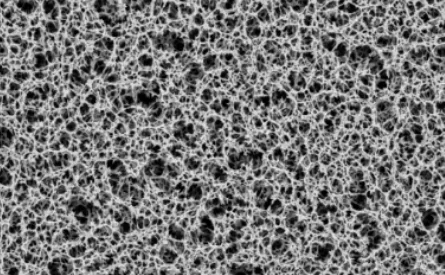
Nitrocellulose membrane, commonly known as NC membrane, is derived from cellulose. Through nitration and membrane-forming processes, it becomes a protein-binding support material suitable for Western blotting and other blotting applications.
NC membranes bind proteins through multiple interactions, including hydrogen bonding, dipole interactions, ionic interactions, and hydrophobic interactions. This allows them to capture and immobilize a wide range of proteins effectively.
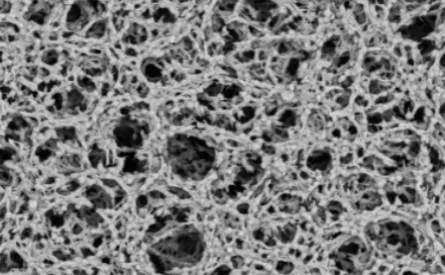
PVDF membrane, or polyvinylidene fluoride membrane, is made from a synthetic fluoropolymer. It primarily binds proteins through hydrophobic interactions. Due to its strong protein-binding capacity and chemical stability, PVDF is often selected for more demanding Western blot applications.
One of the most important differences between NC and PVDF membranes is protein binding capacity.
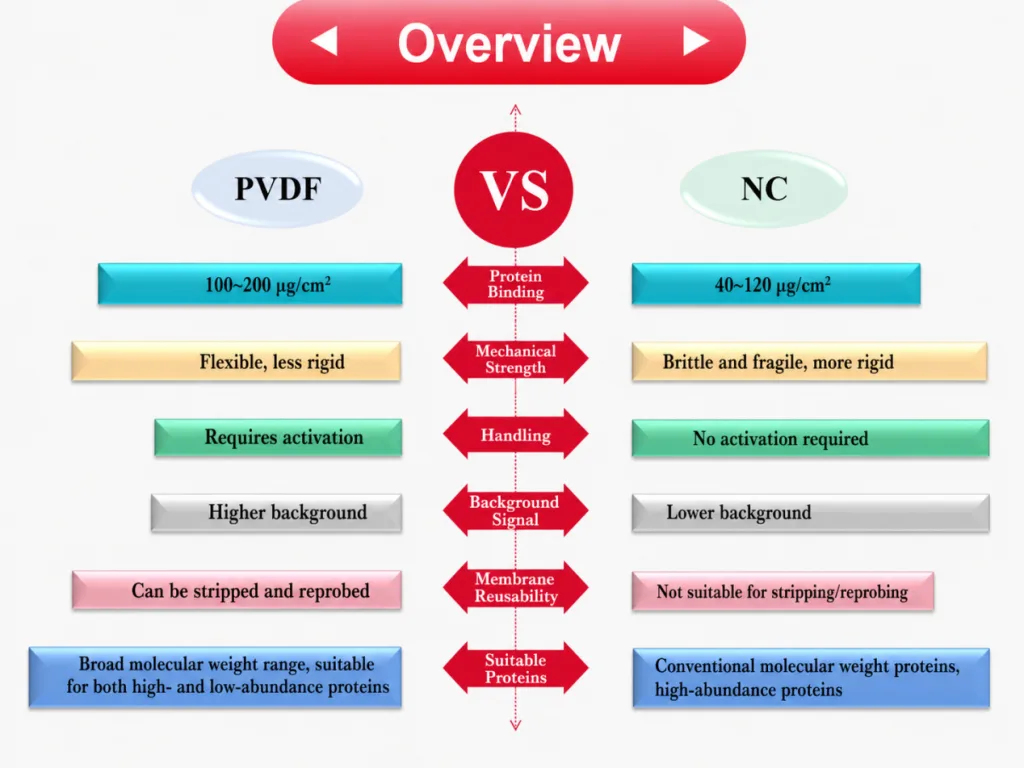
NC membranes typically offer a protein binding capacity of approximately 40–120 μg/cm², making them suitable for many routine Western blot experiments, especially when target proteins are relatively abundant.
PVDF membranes generally provide a higher binding capacity, around 100–200 μg/cm². This makes PVDF a strong choice for detecting low-abundance proteins, limited sample quantities, or targets that require enhanced signal retention.
NC membranes are relatively crisp and easy to handle in routine workflows, but they can be brittle. Careful handling is required during transfer, washing, blocking, antibody incubation, and imaging.
PVDF membranes offer higher mechanical strength and better flexibility. They are more resistant to repeated washing, incubation, and stripping procedures. This makes PVDF particularly useful when researchers need to reprobe the same blot multiple times or perform extended experimental workflows.
NC membranes are easy to use because they do not require a pre-activation step before transfer. This makes them convenient for standard Western blot procedures and helps simplify the workflow.
PVDF membranes, on the other hand, are highly hydrophobic and usually require activation before use, commonly with methanol. While this adds one extra step, the improved binding capacity and durability can be valuable for more complex experiments.
NC membranes are known for their relatively low background and good signal-to-noise performance. They are often more forgiving when it comes to blocking conditions and washing procedures.
PVDF membranes, because of their higher protein binding capacity, may also bind more nonspecific proteins or antibodies if blocking and washing are not optimized. As a result, PVDF can deliver strong signals, but it may require more careful background control.
For researchers working with sensitive detection systems or low-abundance targets, optimization of blocking buffer, antibody concentration, and washing conditions is especially important when using PVDF.
NC membranes are well suited for routine Western blotting and are often preferred for high-abundance proteins or proteins with low to medium molecular weights.
PVDF membranes are more versatile across a broader molecular weight range. They are especially useful for low-abundance proteins, high-molecular-weight proteins, phosphorylated proteins involved in signaling pathways, and hydrophobic membrane proteins.
In short, NC is often a practical choice for standard experiments, while PVDF is better suited for more demanding applications.
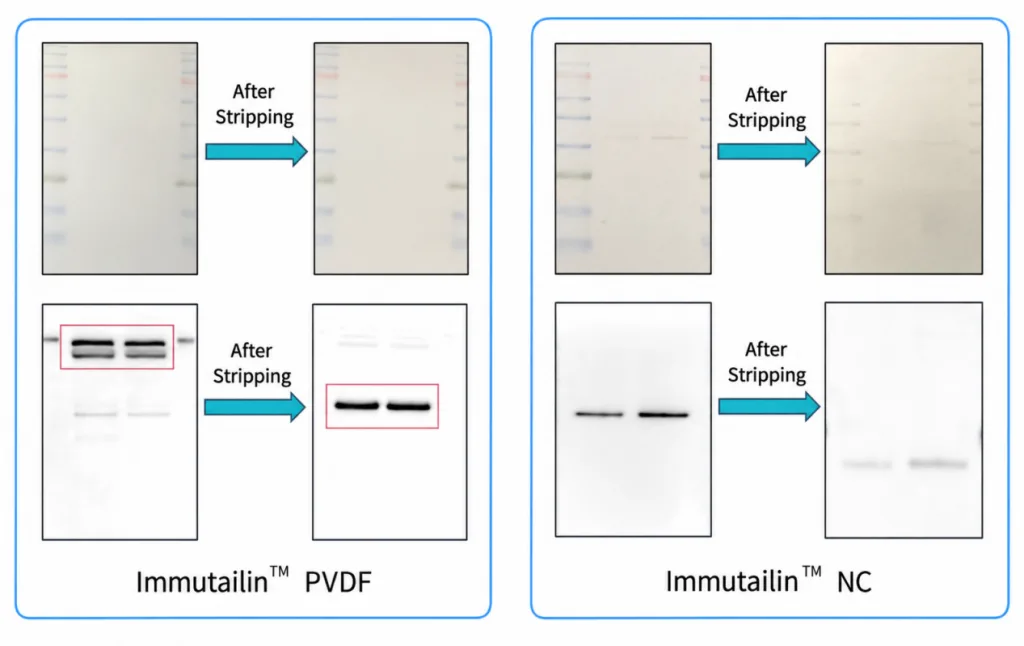
For experiments that require stripping and reprobing, PVDF generally performs better than NC.
PVDF has stronger chemical resistance and can better tolerate stripping buffers, solvents, and repeated processing. After stripping, PVDF membranes can often maintain clear protein marker bands and target protein signals with limited signal loss.
NC membranes, by comparison, are more likely to show reduced band intensity or blurred markers after stripping. For researchers who need to detect multiple targets on the same membrane, PVDF is usually the more reliable option.
The choice between NC and PVDF should be based on the experimental goal, target protein characteristics, detection requirements, and workflow preferences.
For routine Western blotting, high-abundance proteins, simple workflows, or cost-sensitive experiments, NC membrane is often a dependable option.
For low-abundance proteins, high-molecular-weight proteins, hydrophobic proteins, phosphorylated proteins, or experiments requiring repeated stripping and reprobing, PVDF membrane is usually the better choice.
There is no single membrane that fits every experiment. The best choice is the one that matches the biology of the target protein and the requirements of the detection system.
At Tailin, we are committed to supporting life science research with stable and reliable blotting membrane solutions.
Tailin’s NC blotting membrane and PVDF blotting membrane are developed to meet different Western blotting needs, helping researchers improve transfer performance, signal quality, and workflow consistency.
In protein analysis, every detail matters. Choosing the right membrane is not just a technical step — it is part of building a more reliable and reproducible experiment.
For more information or to explore partnership opportunities, please visit our website or contact us at phone: +86 571 8658 9087, email: marketing@tailingood.com. Stay connected with Tailin through our social media channels on Facebook, YouTube, LinkedIn and Instagram to witness our ongoing journey toward excellence and innovation.
Read Our One More Blog: OEB 5 Containment Isolator for High-Potency Weighing and Sampling: Balancing Safety, Accuracy, and Compliance